


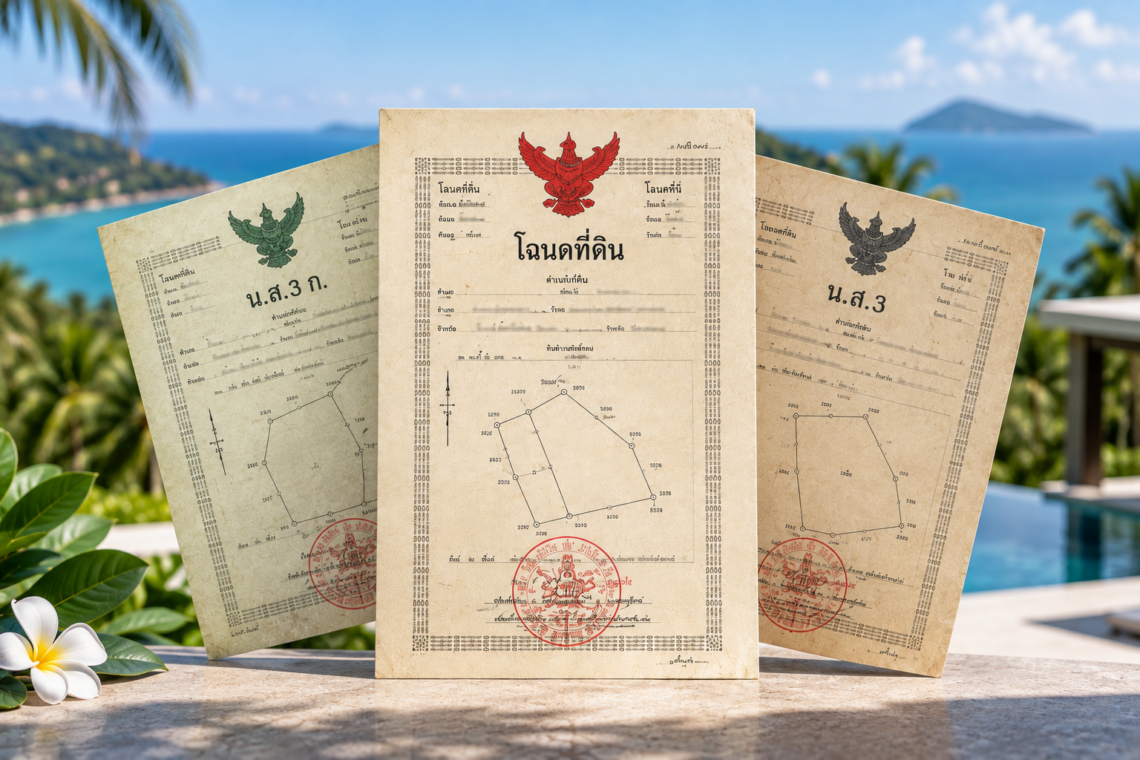
When buying a villa or land in Koh Samui, one of the most important things to understand is the land title.
Thailand has several different forms of land documentation, and they do not all provide the same rights. A property may be described as having a title deed, land document or ownership document, but buyers should establish exactly what type of document exists and what rights it provides.
For most buyers looking at property for sale in Koh Samui, the name they will hear most frequently is Chanote. However, other land documents including Nor Sor 3 Gor, Nor Sor 3 and Sor Kor 1 also exist.
This guide explains the main Thai land titles and what property buyers should understand before purchasing land or a villa.
Why Are Land Titles Important in Thailand?
A land document helps establish the legal status of a parcel of land, including the rights held by the person named on the document.
The type of document can affect issues such as:
- Ownership or possessory rights
- How accurately the land boundaries are defined
- Whether the land can be sold or transferred
- Whether rights such as leases or mortgages can be registered
- How easily the boundaries can be verified
- Whether the document may potentially be upgraded to a stronger form of title
For this reason, two neighbouring pieces of land can have very different legal characteristics even if they appear almost identical when viewed in person.
What Is a Chanote Title Deed?
A Chanote, commonly referred to as Nor Sor 4 Jor (N.S.4 Jor), is generally regarded as the strongest and most complete form of land title in Thailand.
It provides evidence of ownership and identifies the parcel through an official cadastral survey.
For property buyers, one of the important advantages of Chanote land is the greater certainty concerning the location and boundaries of the parcel compared with less precise forms of land documentation.
Rights and transactions concerning Chanote land can be registered with the relevant Land Office, subject to applicable Thai law.
For these reasons, Chanote land in Koh Samui is normally the preferred starting point for buyers purchasing established villas or development land.
Does Chanote Mean the Property Is Automatically Safe to Buy?
No.
A Chanote is an important part of a property transaction, but its existence does not replace proper legal due diligence.
A buyer’s lawyer should still verify the title and investigate relevant registrations at the Land Office.
This can include checking:
- The registered owner
- The land area and title details
- Mortgages or other registered encumbrances
- Registered leases
- Servitudes and access rights
- Other rights registered against the land
The physical property should also correspond with what is being sold. A villa standing on Chanote land can still have issues involving access, construction documentation, boundaries, drainage or neighbouring land.
Chanote should therefore be viewed as a strong form of land title, not as a substitute for investigating the property itself.
What Is Nor Sor 3 Gor?
Nor Sor 3 Gor (N.S.3 Gor) is a Certificate of Utilisation rather than a Chanote title deed.
It certifies recognised rights over land that has been occupied and put to use and provides considerably more certainty than basic possession documentation.
Nor Sor 3 Gor land is mapped using an aerial survey system, allowing the parcel to be identified with greater accuracy than older Nor Sor 3 documentation.
Nor Sor 3 Gor can therefore represent meaningful and transferable land rights, but buyers should not simply treat it as identical to Chanote.
Depending on the land and applicable procedures, Nor Sor 3 Gor land may potentially be eligible for conversion to Chanote.
Where a property is offered on Nor Sor 3 Gor land, the document, boundaries and any proposed upgrade should be independently investigated rather than assuming that conversion to Chanote is automatic.
What Is Nor Sor 3?
Nor Sor 3 (N.S.3) is also a Certificate of Utilisation recognising rights over land that has been occupied and used.
The important difference for a buyer is that the parcel is generally not defined using the same level of cadastral mapping associated with Chanote.
Its boundaries can therefore be less precisely established.
This does not mean that Nor Sor 3 land has no value or cannot be transacted. It means that the buyer should pay particular attention to the survey, boundaries, neighbouring parcels and Land Office records.
Where older land documentation is involved, the difference between the land described in documents and the land physically being shown to a buyer deserves careful investigation.
What Is Nor Sor 3 Khor?
Nor Sor 3 Khor (N.S.3 Khor) is another form of Certificate of Utilisation recognised within Thailand’s land-document system.
It belongs to the same broader category of documentation as Nor Sor 3 and Nor Sor 3 Gor, rather than being a full Chanote title deed.
For an ordinary property buyer, the important point is not simply memorising the different Thai abbreviations. It is understanding exactly which document applies to the land being purchased and what rights, boundaries and registrations are associated with that particular parcel.
What Is Nor Sor 2?
Nor Sor 2 (N.S.2), sometimes referred to as a pre-emptive certificate or reservation document, represents a more limited stage in Thailand’s land-right system.
It should not be confused with a Chanote or treated as equivalent to full land ownership.
For most international buyers looking for completed villas for sale in Koh Samui, encountering land held only under this type of documentation should trigger considerably more investigation before any commitment is made.
What Is Sor Kor 1?
Sor Kor 1 (S.K.1) is fundamentally different from a Chanote.
It is a notification of possession relating to land occupation rather than a modern title deed establishing the same form of registered ownership as Chanote.
Sor Kor 1 documents have historically played a role in establishing claims that could, where legally eligible and after the appropriate process, lead to stronger land documentation.
However, buyers should never assume that land associated with Sor Kor 1 can simply or automatically be converted into Chanote.
The history, location, eligibility and documentation of the individual parcel require careful legal investigation.
What Is the Difference Between Ownership and Possession?
This distinction helps explain why Thailand’s various land documents should not simply be regarded as different versions of the same title deed.
A Chanote is a title deed evidencing ownership.
Other documents may instead certify utilisation or relate to possession of the land.
That difference can affect how the land is surveyed, transferred, registered and ultimately treated in a property transaction.
This is why a buyer should ask for the exact type of land document rather than simply asking whether the property has a title.
Can a Nor Sor 3 Gor Be Upgraded to Chanote?
In appropriate circumstances, certain land held under Certificates of Utilisation can be eligible for the issuance of a Chanote.
However, this should never be treated as guaranteed merely because a seller, developer or agent says that the land is “upgradeable”.
Eligibility depends on the land, its documentation, surveys and the requirements of the Department of Lands.
If the proposed purchase depends on obtaining a Chanote in the future, the buyer should have this investigated independently before committing to the transaction.
Why Are Boundaries Particularly Important in Koh Samui?
Koh Samui’s terrain makes accurate boundaries especially important.
Many properties are located on hillsides, reached through private roads or surrounded by irregularly shaped parcels.
A difference between an assumed boundary and the legally recognised boundary can affect:
- Villa positioning
- Swimming pools and terraces
- Retaining walls
- Driveways
- Road access
- Future construction
- Resale of the property
Buyers should therefore avoid relying solely on fences, walls, landscaping or statements about where the seller believes the boundary to be.
Does a Land Title Guarantee Legal Road Access?
No.
This is particularly important when buying property in Koh Samui.
A parcel can have a valid land document while access to it passes across land belonging to somebody else.
The existence of a physical road does not necessarily mean that the property benefits from a permanent registered right to use that road.
Legal access should therefore be investigated separately from the land title itself.
For hillside villas reached through several private parcels, this can be one of the most important parts of property due diligence.
Can Foreigners Own Chanote Land in Thailand?
Having a Chanote does not change Thailand’s restrictions on foreign land ownership.
Foreign ownership of land in Thailand is generally restricted, subject to limited statutory exceptions.
Foreign buyers should therefore not interpret “Chanote title” as meaning that the land can automatically be registered personally in their name.
The land title and the legal structure through which a foreign buyer acquires rights connected with a property are separate issues.
An independent qualified Thai lawyer should advise the buyer on the proposed ownership structure and its legal implications.
What Should a Buyer Ask About the Land Title?
When considering land or a villa on Koh Samui, some basic questions should be answered early in the process:
- What is the exact type of land document?
- Who is registered as the owner or rights holder?
- What is the registered land area?
- Do the physical boundaries correspond with the documentation?
- Are mortgages, leases, servitudes or other rights registered?
- How is legal access to the land secured?
- Does the villa and its associated structures sit within the correct parcel?
- If an upgrade to Chanote is proposed, has its feasibility been independently verified?
These questions do not replace legal due diligence, but they can identify issues that deserve investigation before a buyer progresses too far into a transaction.
Which Land Title Is Best When Buying Property in Koh Samui?
For most conventional property purchases, Chanote is generally the preferred form of land title because it provides the strongest form of documented ownership and the clearest cadastral identification of the land.
That does not mean every property held under another form of land documentation should automatically be rejected.
It does mean that buyers need to understand the difference and assess the additional legal and practical considerations associated with the particular document.
The weaker or less precise the underlying land documentation, the more important careful investigation becomes.
Checking a Land Title Before Buying
A photocopy of a title document is not enough to complete proper due diligence.
The buyer’s lawyer should verify the land and relevant registrations with the appropriate Land Office and investigate the title as part of the wider transaction.
The property itself should also be considered alongside the title. Building documentation, legal access, planning restrictions, utilities, drainage and physical condition remain separate issues.
This is particularly important on Koh Samui, where hillside development, private access roads and irregular terrain can make a property’s legal and physical circumstances more complicated than they first appear.
Understanding Koh Samui Land Before You Buy
For buyers searching for property for sale in Koh Samui, understanding the land underneath a villa is every bit as important as inspecting the villa itself.
Chanote, Nor Sor 3 Gor, Nor Sor 3 and other Thai land documents represent different legal circumstances and should not be treated as interchangeable.
The safest approach is simple: establish exactly what document exists, understand what rights it provides, verify it independently and investigate how the documented land corresponds with the property on the ground.
At Doctor Property, we provide buyers with the available property and land information and coordinate with buyers, sellers and their respective professional advisers throughout the transaction. Independent legal due diligence should always be carried out by a suitably qualified Thai lawyer acting for the buyer.


